
Eye Examination
 Athens EyeCare Clinicathenseyecare.gr · (+30) 210 777 8515
On this page
What is an eye examination?
An eye examination involves a series of tests to assess your vision and check for eye disease. Your eye doctor is likely to use a variety of instruments, shine bright lights into your eyes and ask you to look through an array of lenses. Each test in an eye examination evaluates a different aspect of your vision or eye health.
The different types of eye tests
Eye muscle test
This test assesses the muscles that control eye movement. Your eye doctor watches your eyes as they follow a moving object, such as a pen or a small light, looking for muscle weakness, poor control or poor coordination.
Visual acuity test
This test measures how clearly you see. Your doctor asks you to identify letters of the alphabet printed on a chart or displayed on a screen positioned some distance away.
Each eye is tested separately. Your near vision may also be tested, using a card with letters held at reading distance.
Refraction assessment
Light waves are bent as they pass through your cornea and lens. If the light rays do not focus perfectly on the back of your eye, you have a refractive error. That may mean you need some form of correction, such as glasses, contact lenses or refractive surgery, to see as clearly as possible.
Assessing your refractive error helps your doctor determine the lens prescription that will give you the sharpest, most comfortable vision.
The assessment may equally show that you do not need corrective lenses at all.
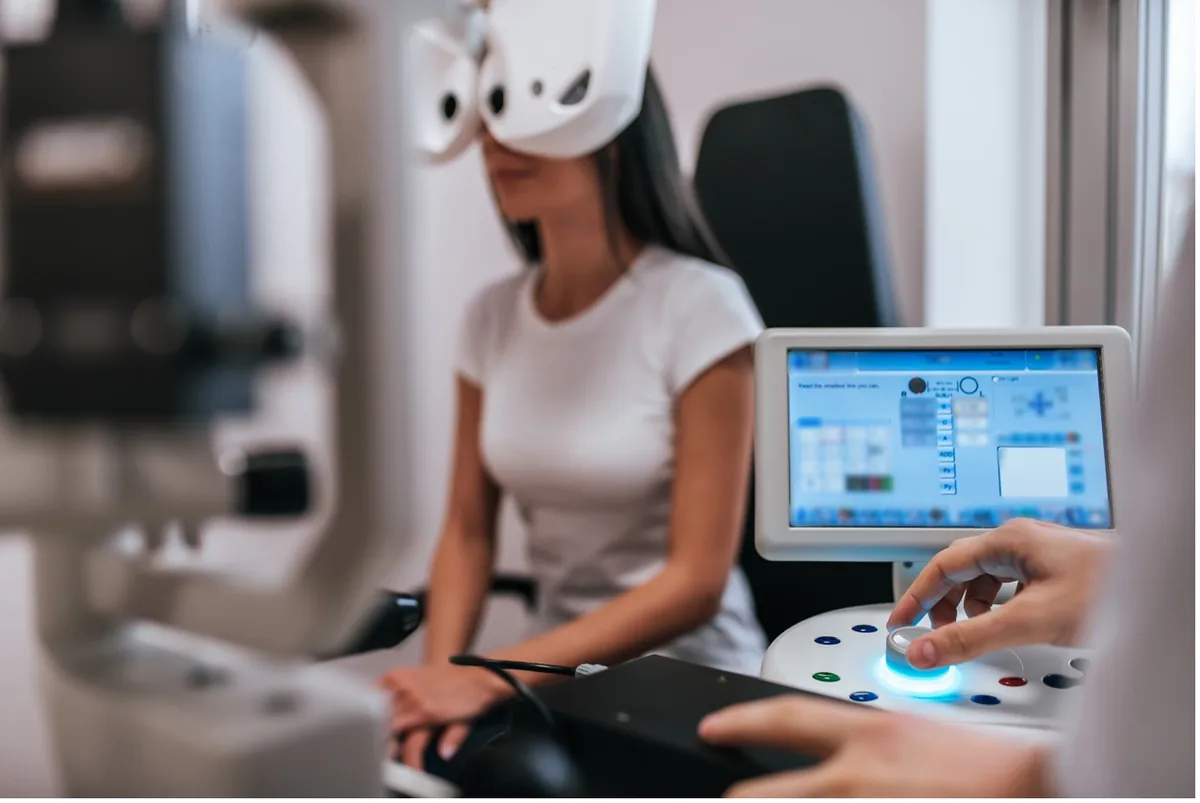
Your doctor may use a computerised refractor to estimate your prescription for glasses or contact lenses, or a technique called retinoscopy, in which the doctor shines a light into your eye and measures the refractive error by observing how the light reflected by your retina moves back through your pupil.
Your eye doctor usually fine-tunes this assessment by asking you to look through a mask-like device containing wheels of different lenses (a phoropter), and to judge which combination of lenses gives you the sharpest vision.
Slit-lamp examination
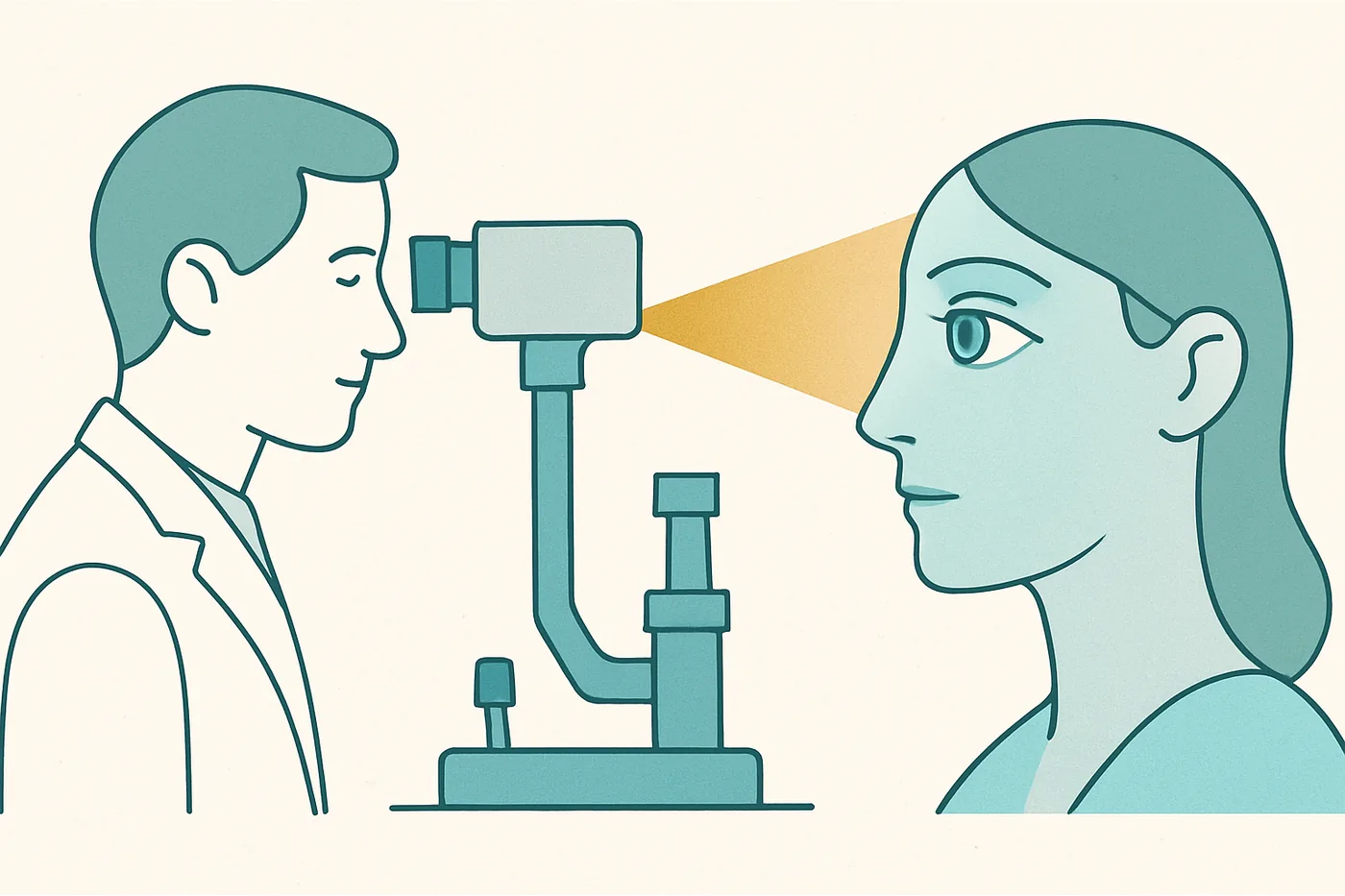
A slit lamp is a microscope that magnifies and illuminates the front of your eye with an intense line of light.
Your doctor uses this device to examine the eyelids, lashes, cornea, iris, lens and the fluid chamber between the cornea and the iris.
Your doctor may use a dye, most commonly fluorescein, to colour the tear film over your eye. This helps reveal damaged cells on the surface of the eye. Your tears wash the dye away fairly quickly.
Retinal examination
This examination, sometimes called ophthalmoscopy or fundoscopy, allows your doctor to evaluate the back of your eye, including the retina, the optic disc and the retinal blood vessels that nourish the retina. Dilating your pupils with eye drops before the examination keeps them from constricting when your doctor shines light into the eye.
After administering the eye drops and giving them time to work, your eye doctor may use one or more of the following techniques to view the back of your eye:
Direct examination. Your eye doctor uses an ophthalmoscope to shine a beam of light through your pupil and view the back of the eye. Dilating drops are sometimes unnecessary for this examination.
Indirect examination. For this examination you might sit up or recline in the examination chair. Your eye doctor examines the inside of the eye using a condensing lens and a bright light mounted on their forehead. This technique lets your doctor see the retina and the other structures inside your eye in great detail, and in three dimensions.
The results of an eye examination tell you:
Whether you need vision correction, whether with glasses, contact lenses or surgery
Whether your eyes are healthy, or whether you have cataracts, glaucoma or a retinal disorder such as macular degeneration or diabetic retinopathy.
If you need corrective lenses, your doctor will give you a prescription. If your eye examination reveals any other abnormal results, your doctor will discuss the next steps with you, whether that means further testing or treating an underlying condition.