
Visual Field Test
 Athens EyeCare Clinicathenseyecare.gr · (+30) 210 777 8515
On this page
- What is a visual field test?
- A visual field test measures two things:
- Why do people need a visual field test?
- Why do some people need visual field tests many times?
- Factors that can affect the results
- Who is a visual field test recommended for?
- What happens during a visual field test?
- What do the results of a visual field test mean?
What is a visual field test?
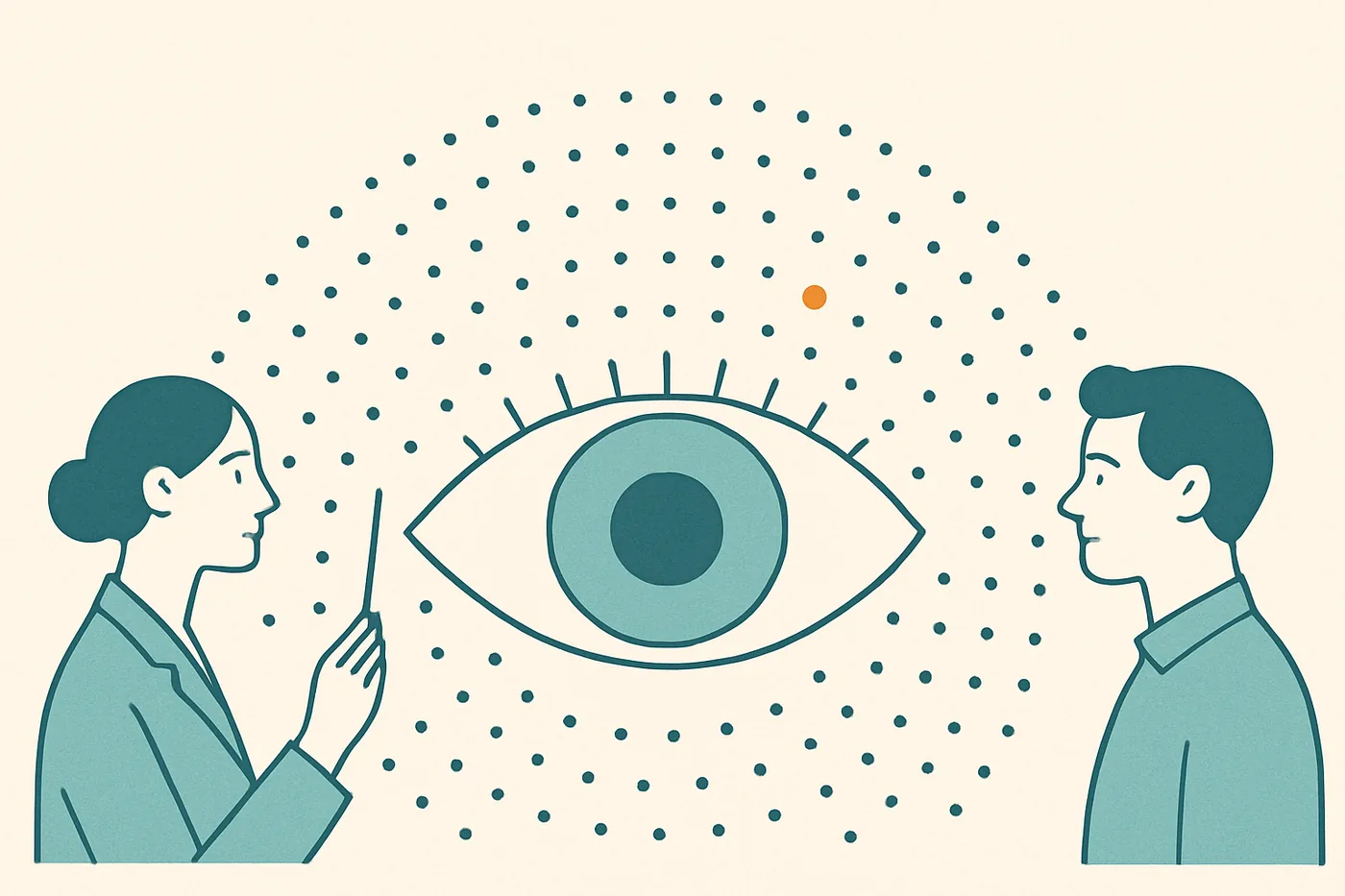
We normally see a wide area of the space in front of us. Without moving our eyes, we see not only what lies straight ahead, but also some of what is above, below and off to either side. Most people know this as “peripheral vision”. The entire area we can see is called the visual field.
Vision is usually sharpest right in the middle of the visual field, which is why we turn our eyes towards anything we want to see better. The further an object is from the centre of our vision, the less clearly we see it — and once it moves far enough to the side, it disappears from view completely.
A visual field test measures two things:
How far up, down, left and right the eye can see without moving.
How sensitive vision is in different parts of the visual field.
Why do people need a visual field test?
A visual field test can help the doctor find early signs of diseases such as glaucoma that damage vision gradually. Some people with glaucoma notice no problems with their sight, yet the visual field test shows that their peripheral vision is being lost.
A visual field test can also tell the doctor more about the part of the nervous system that allows us to see. The visual pathway includes the retina (the “film” in the camera-like eye), the optic nerve (the “cable” that carries images from the retina to the brain), and the brain itself. A problem anywhere in this system can change the visual field, and there are well-recognised patterns in the results that help doctors identify particular types of injury or disease. By repeating visual field tests at regular intervals, doctors can also tell whether a patient is getting better or worse.
Why do some people need visual field tests many times?
Sometimes the doctor will want to repeat the test straight away to make sure the results are accurate — if the patient is tired, for example, the results can be unreliable.
Your doctor might also recommend repeating the test in a few weeks, a few months or a year, to make sure no new problems have developed. Once a condition such as glaucoma has been found, visual field tests are performed regularly to see how well the treatment is working.
Visual field tests are especially important in the management of glaucoma, because they can show the doctor that vision is being lost before the patient notices anything. That is just one of the reasons why people with glaucoma need to keep all their appointments with their doctor.
Factors that can affect the results
Some factors can affect the quality and reliability of the test without necessarily meaning that anything is wrong. They include:
- Marked tiredness or drowsiness
- Anxiety during the test
- Reduced concentration
- Unfamiliarity with the procedure
- Discomfort during the test
For this reason, the results are always assessed together with the clinical picture.
Who is a visual field test recommended for?
Visual field testing is used across a wide range of clinical situations, both to make a diagnosis and to monitor a condition over time. It is particularly indicated for:
- People with known or suspected glaucoma
- Patients with diseases of the optic nerve
- Neurological conditions that may affect the visual pathway
- Unexplained loss of vision
- Patients with a history of head injury or stroke
In some cases the test is also used preventively, when the doctor needs to assess a patient's vision.
What happens during a visual field test?
There are several types of visual field test, but they all share one feature: the patient looks straight ahead at a single point and signals whenever an object or a light appears somewhere off to the side.
If the patient turns their eye to look directly at the object or light, only the very centre of the visual field is tested. The examiner will explain exactly where to look so that the test is accurate.
The instrument has a large central “target” for the patient to fixate on, keeping the centre of the visual field steady.
It uses tiny spots of light to test vision, and the brightness and colour of the light can be varied to measure the sensitivity of vision at each location.
These tests have been given to thousands of healthy people, so the “normal” results are well established, and the instrument compares each new test against these standards.
What do the results of a visual field test mean?
A “normal” visual field test means the patient sees about as well as anyone else, both in the centre and around the edges of the visual field.
A result showing visual field loss means that vision in some areas is less sensitive than normal. This may be a small amount of vision lost in one small area, or all vision lost across large areas.
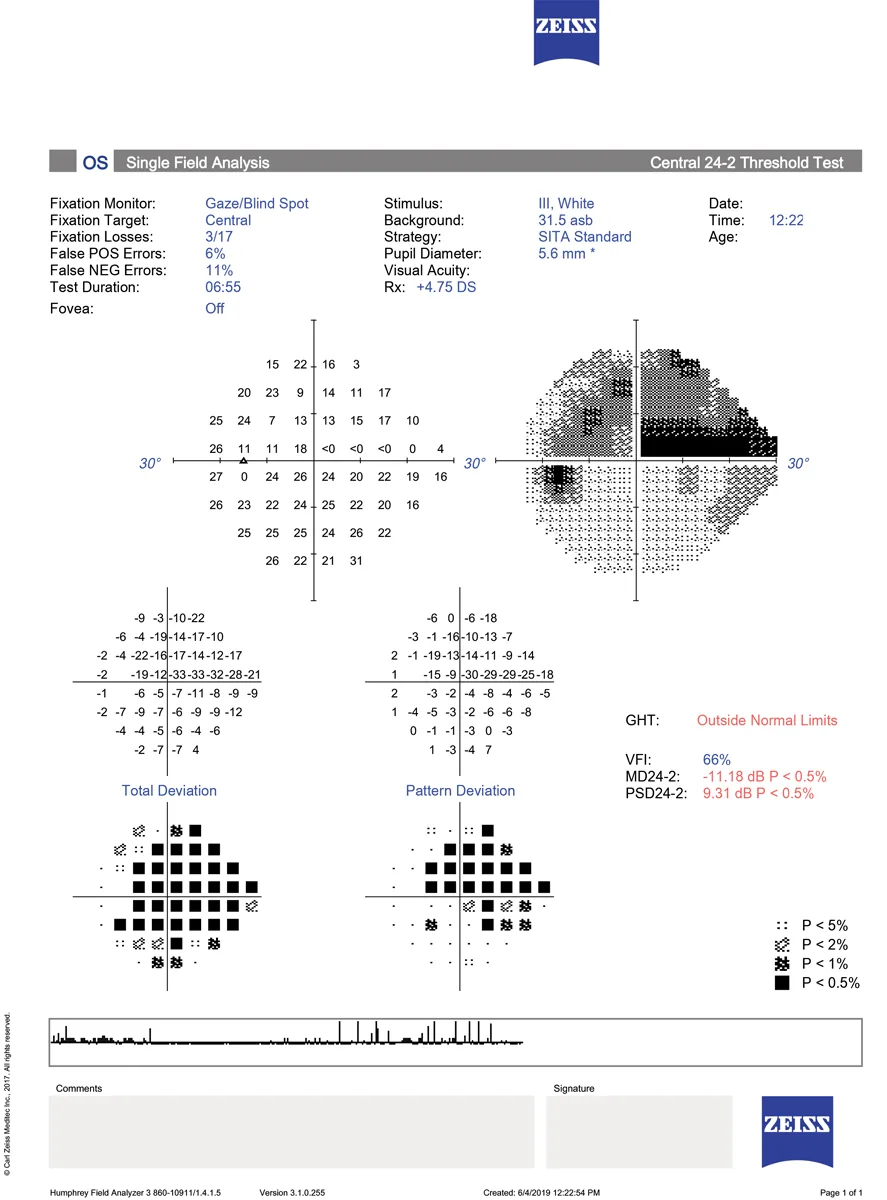
The visual field test measures how much vision has been lost and which areas are affected. The instrument prints the results as patterns of dots or numbers, and these patterns tell the doctor a great deal about how the eye and the visual system are working. They help your doctor decide whether you have a condition that needs further testing to diagnose, or whether treatment should be recommended.
Athens EyeCare Clinic has the most advanced visual field instrument on the market, the Humphrey Visual Field HFA3 860, with an automated liquid trial lens.